
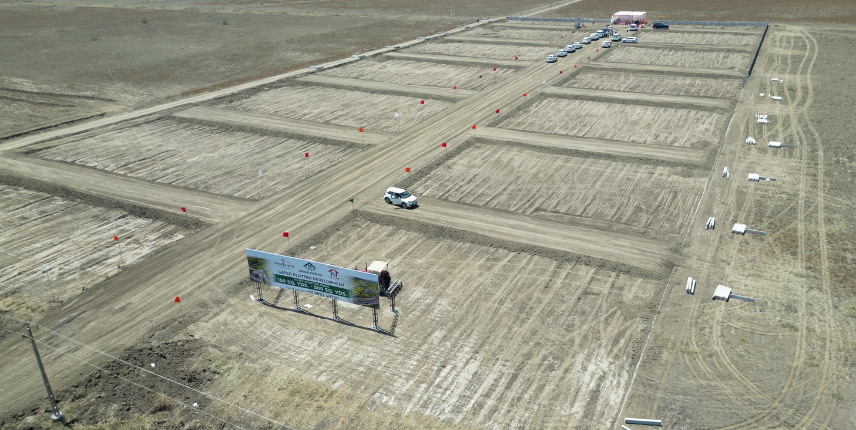
Dholera is attracting increasing attention because of infrastructure, industrial development, semiconductor investment and long-term urban planning.
But interest should never replace due diligence.
A plot may look attractive on a brochure.
A price may look affordable.
A seller may talk about future roads, airport connectivity or industrial growth.
But before paying even a token amount, you should understand exactly:
what you are buying, where it is, what exists today, and what is still only expected in the future.
The source book itself repeatedly stresses that investors should track actual progress rather than announcements and conduct thorough due diligence before making commitments.
That principle should come before everything else.
1. Verify the Exact Location
Never buy land based only on a phrase such as:
“Dholera plot”
or
“Near Dholera Smart City”
Ask for the exact location.
You should understand:
- village/location;
- access road;
- surrounding development;
- proximity to major infrastructure;
- nearby economic activity; and
- how the site relates to the wider Dholera development story.
Two plots marketed as “Dholera” can have very different development contexts.
2. Understand What Exists Today
One of the biggest mistakes buyers make is treating future infrastructure as current infrastructure.
Separate everything into:
Existing Today
Roads, utilities, operational access and visible development.
Under Development
Infrastructure that is physically being executed.
Future/Planned
Projects that may be part of a longer-term development vision.
This distinction matters because Dholera remains an evolving project.
The book itself says the region is no longer merely a master plan, but also makes clear that its development journey is still far from complete.
3. Check Connectivity Properly
Do not stop at:
“The expressway is nearby.”
Ask:
- How do I actually reach the plot?
- What is the current road condition?
- Is there direct or indirect access?
- How far is the nearest major corridor?
- How does the location connect to Ahmedabad?
- How does it relate to future industrial activity?
The 109 km Ahmedabad–Dholera Expressway is an important regional connectivity asset, but local access remains equally important. The book records the expressway as inaugurated in March 2026. Dholera_Book_Final_Preview
A major highway nearby does not automatically make every plot equally well connected.
4. Study the Economic Drivers Around the Location
A property becomes relevant when people or businesses eventually have a reason to use that location.
Look for economic drivers such as:
- industrial activity;
- manufacturing;
- semiconductor ecosystem;
- logistics;
- business development;
- employment creation; and
- population growth.
The book’s real-estate section makes an important point:
real estate follows economic activity.
Industries need factories.
Employees need homes.
Businesses need offices.
Warehouses need logistics space.
People create demand for shops, healthcare, education and services.
So don’t evaluate land in isolation.
Evaluate the economy that may eventually create demand for it.
5. Do Not Buy Only Because a Big Project Is Nearby
The Tata semiconductor project, airport, expressway and Activation Area are all important developments.
But a nearby landmark should not become your entire investment thesis.
Ask:
How exactly could this infrastructure benefit this specific location?
For example:
A major industrial project may create jobs.
Jobs may create housing demand.
Suppliers may require logistics.
Businesses may require commercial space.
But those effects can spread differently across locations and can take time.
The source book itself notes that Dholera’s future depends on the wider ecosystem of infrastructure, industries, talent and investment rather than on one project alone.
6. Understand the Development Timeline
Dholera is a long-term development story.
That is very different from buying property in an already established neighbourhood.
Large development projects face potential risks such as:
- execution delays;
- policy changes;
- market fluctuations;
- global economic shifts; and
- variations in private investment.
The book openly discusses these risks and advises investors to track infrastructure, policy and market developments closely.
So ask yourself:
How long am I realistically prepared to hold this investment?
That question is often more important than asking what the price may be next year.
7. Check the Documentation Before Paying
This is one area where you should not rely only on marketing material.
Before committing money, independently verify the relevant property documents and legal position through appropriate professionals and authorities.
The source book itself does not provide a plot-by-plot legal-document checklist, so specific documentation requirements should be verified with a qualified local property lawyer and the applicable government records.
At minimum, do not proceed merely because:
- the brochure looks professional;
- the salesperson is confident;
- the location appears attractive on Google Maps; or
- somebody promises future appreciation.
Marketing cannot replace legal verification.
8. Compare Price With Location — Not With Another Advertisement
Suppose one plot is available at ₹X and another at ₹Y.
The cheaper one is not automatically better.
Compare the price against:
- location;
- accessibility;
- infrastructure;
- surrounding economic activity;
- development horizon;
- documentation;
- and risk.
A lower price may simply reflect a longer development timeline or weaker current connectivity.
A higher price may also be unjustified.
The important question is:
What am I paying for?
9. Don’t Believe Guaranteed Return Claims
Emerging markets naturally create excitement.
But no responsible investment analysis can guarantee:
- doubling;
- fixed appreciation;
- specific annual returns; or
- a guaranteed resale timeline.
The book explicitly states that Dholera has both opportunity and risk, including policy changes, execution delays and market conditions.
Its central recommendation is to focus on long-term fundamentals, not short-term speculation.
Those fundamentals include:
Infrastructure
Industrial Expansion
Employment
Business Activity
Connectivity
Population Growth
10. Visit the Location Before You Decide
This is perhaps the simplest but most valuable step.
A site visit can help you understand things that a brochure cannot show clearly:
- actual approach road;
- surrounding land;
- nearby activity;
- physical infrastructure;
- distance between landmarks;
- ground conditions; and
- how the location actually feels in context.
When visiting, don’t just ask:
“Which plot is mine?”
Ask:
“Show me why this location matters.”
That creates a much more useful conversation.
The 3-Map Rule Before Buying in Dholera
Before considering a property, try to understand it on three different maps:
1. Regional Map
Where is it relative to Ahmedabad, the expressway, airport and major regional connectivity?
2. Dholera Development Map
Where is it relative to Dholera’s infrastructure and broader development?
3. Property-Level Map
Where exactly is the plot, its road access and surrounding land?
A property can look attractive on one map and very different when examined on all three.
The 3-Time-Horizon Rule
Evaluate every Dholera claim in three time periods:
Today
What already exists?
Next Development Phase
What is actively being executed?
Long Term
What depends on future growth and planning?
This helps prevent future projections from being presented as present-day reality.
What Makes Dholera Interesting in the First Place?
The reason investors are studying Dholera is not one isolated property project.
It is the convergence of multiple growth drivers.
The source book identifies:
- infrastructure development;
- industrial expansion;
- semiconductor investment;
- connectivity projects;
- policy support; and
- future urban growth
as important parts of Dholera’s investment landscape.
At the same time, it warns that these factors do not guarantee investment success.
That balance is important.
Infrastructure Is Already an Important Part of the Story
The first-phase Activation Area covers approximately 22.5 sq km, with around 72 km of roads and utility networks, alongside major water and wastewater infrastructure. Dholera_Book_Final_Preview
This gives investors something tangible to evaluate.
But even visible infrastructure should be considered alongside the specific location being offered.
A plot’s value proposition is ultimately local.
The Semiconductor Opportunity
The Tata Electronics–PSMC fab has become one of Dholera’s most important industrial milestones.
The book records the project at up to approximately ₹91,000 crore with planned capacity of up to 50,000 wafers per month, with commercial production expected around mid-2028 based on information available when the book was prepared. Dholera_Book_Final_Preview
The opportunity here is not simply the factory.
The broader possibility is the ecosystem that could emerge around it:
Fab
→ Suppliers
→ Engineering
→ Logistics
→ Services
→ Employment
→ Housing
→ Commercial Demand
That broader chain is much more important for long-term real estate than a headline alone.
A Simple Pre-Token Checklist
Before paying any amount, be able to answer:
| Question | Answer |
|---|---|
| Where exactly is the property? | ✓ |
| What exists around it today? | ✓ |
| What is under development? | ✓ |
| What is only proposed? | ✓ |
| How is the property accessed? | ✓ |
| What economic driver supports future demand? | ✓ |
| Has documentation been independently checked? | ✓ |
| Does the price make sense for the location? | ✓ |
| What risks could affect the investment? | ✓ |
| What is my realistic holding period? | ✓ |
If several answers are still unclear, don’t rush to pay a token.
Red Flags to Watch For
Be cautious when the entire sales pitch depends on statements such as:
“Guaranteed return.”
“Price will double.”
“Last plot available.”
“Airport plot.”
“Expressway-touch.”
“Government project means zero risk.”
“Pay today or lose the opportunity.”
A good property should still make sense after the urgency is removed.
What a Good Dholera Investment Conversation Should Sound Like
Not:
“Sir, price will double.”
But:
“Here is the exact location. Here is what exists today. Here is what is currently under development. Here are the economic drivers around it. Here is what still depends on future execution. Now let’s see whether it fits your objective.”
That is the type of transparency investors should demand.
Check Before You Pay
At Dholeraa.com by TNT Infra, our approach should be simple:
Don’t pay first and investigate later.
Investigate first. Understand the location. Then decide.
Before you pay a token, let us help you look at:
Location
→ Connectivity
→ Ground Reality
→ Infrastructure
→ Development Context
→ Documentation